

A leopard sighting can be over in seconds.
Or it can unfold slowly…
A leopard appears beside the road. The vehicle stops. The engine goes quiet. It settles beneath a tree, gets up again, crosses through the grass and disappears from view. Then everyone waits.
Finding the leopard is one part of the experience. Having the time and space to watch what happens next is another.
On a private reserve safari, some of the greatest luxuries have very little to do with what is waiting back at the lodge. They are found out here: time, patience, space and the opportunity to stay with a wildlife encounter as it unfolds.
At Karongwe, that can change the way you experience one of Africa’s most elusive big cats.
Karongwe at a Glance:
- Private Big Five game reserve located within the UNESCO-recognised Kruger to Canyons Biosphere, just outside Hoedspruit
- Proud member of the Greater Kruger Environmental Protection Foundation (GKEPF)
- Six river systems create diverse wildlife habitats.
- Home to the Big Five, cheetah and African wild dog.
- Six distinctive luxury safari lodges, including Sepela Explorer Camp opening in April 2027
- Experienced guides and trackers delivering immersive wildlife encounters
- Guided by the philosophy of Safari with Soul—where conservation, regeneration and genuine hospitality come together
The Search Is Only the Beginning
Leopards are exceptionally well camouflaged and generally solitary, which means finding one can require patience.
Tracks in the road, an alarm call or the behaviour of nearby animals may give Karongwe’s guides and trackers a reason to slow down and look more closely.
But this article isn’t really about how a leopard is found.
It’s about what happens after it is.
A leopard resting beneath a tree may begin to move. One lying in the shade may suddenly become alert to something nearby. An animal walking through the bush may stop, listen, change direction or disappear completely.
The longer you are able to observe, the more a sighting can become about behaviour rather than simply presence.
Finding it gives you the sighting. Staying with it gives you the story.
What Changes on a Private Reserve Safari?
While no leopard sighting can ever be guaranteed, the environment you explore plays a significant role in your chances of finding one. Karongwe’s diverse landscapes, experienced guides, and intimate safari experience create the ideal setting for unforgettable encounters.
Time at the Sighting
There is a difference between seeing a leopard and spending enough time with it to notice what it is doing.
A quick sighting may give you the photograph. Time reveals the details: where the leopard is looking, what it is listening to, whether it is resting or becoming active, and how other animals respond to its presence.
Not every encounter needs to be rushed towards the next one.
Sometimes the most interesting decision is simply to stay.
Space to Let the Sighting Unfold
Wildlife encounters don’t follow a script.
A leopard may remain visible beside the road. It may move through thicker vegetation. It may disappear and reappear somewhere unexpected.
The role of the guide is not simply to get closer, but to read the animal’s behaviour, the terrain and the conditions around the sighting.
The best position isn’t always the closest one.
Sometimes space is what allows an encounter to unfold naturally.
The Freedom to Wait
There are moments on safari when nothing appears to be happening.
Those can be the moments worth waiting through.
A sleeping leopard may lift its head. A distant alarm call may catch its attention. A change in light or temperature may bring movement.
There is no guarantee that waiting will reward you.
But on safari, five more minutes can change everything.
What Makes a Luxury Leopard Safari Different?
Luxury on safari is easy to associate with suites, food and service. Out in the reserve, it can mean something different.
Time to watch. Space to observe. Experienced people who know when to move — and when not to.
A leopard sighting makes that distinction particularly clear.
Seeing More Than the Leopard
Once a leopard has been found, the questions change. Is it resting or alert? What has caught its attention? Why has it chosen that particular position? What are the animals around it doing?
Karongwe’s safari guides and trackers help guests interpret what is happening rather than simply identifying what they are looking at.
A leopard in a tree is a sighting. Understanding why it is there and what might happen next turns it into something more.
Excellent Photography Opportunities
A leopard is an obvious photographic subject. But one of the advantages of having time at a sighting is that the experience doesn’t have to end once you’ve taken the photograph.
Put the camera down for a moment.
Watch where the leopard looks. Notice its ears responding to sounds you haven’t heard. Watch its tail. Look at what is happening beyond the frame.
Sometimes the photograph is the thing you take home. Sometimes it’s the moment after you took it.
Comfort Between Game Drives
Eventually, the vehicle moves on. Back at the lodge, the pace changes again. Breakfast after a morning drive. A long lunch. A few quiet hours beside the pool or in your suite before heading back into the reserve later that afternoon.
Karongwe’s six safari lodges each offer a different setting and style, but they share the same wider wildlife landscape.
The contrast is part of the experience: hours spent watching the bush, followed by hours with nowhere you particularly need to be.
You Can’t Schedule a Leopard Sighting
You can book the lodge. You can choose the season. You can be ready when the game-drive vehicle leaves.
You cannot book the leopard. Wildlife moves according to its own rhythms, and no responsible safari can guarantee what will appear on a particular drive.
Some leopard sightings happen after a long search. Others happen when nobody was looking for a leopard at all.
That unpredictability is not something a luxury safari removes.
It is something a good safari gives you the time to appreciate.


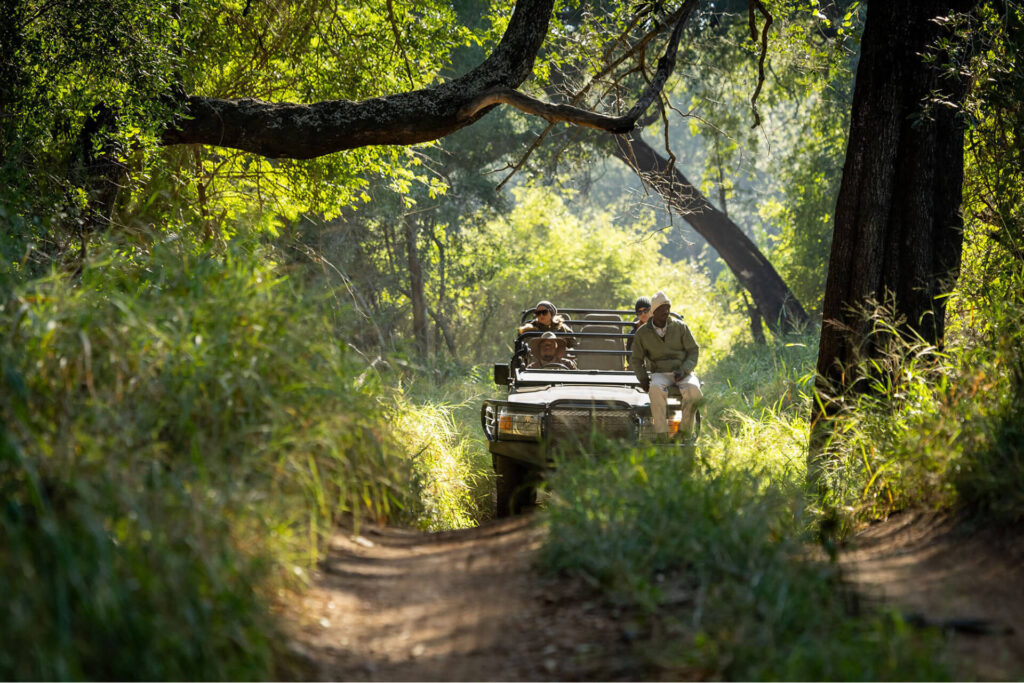


A Leopard Sighting at Karongwe
Karongwe is a private Big Five reserve near Hoedspruit, within the UNESCO-recognised Kruger to Canyons Biosphere.
Six river systems shape a landscape of varied habitats, including riverine vegetation and areas of denser cover. Leopard shares this landscape with lion, elephant, rhino and buffalo, as well as cheetah, African wild dog and a much wider diversity of wildlife.
Twice-daily game drives are led by experienced safari guides and trackers who spend their days reading this landscape and the animals moving through it.
And when a leopard is found, the aim isn’t simply to tick it off the list. Stay a little longer. Watch what happens next.
Experience the Thrill of Seeing a Wild Leopard
A leopard may stay for twenty minutes. It may disappear in twenty seconds.
Either way, the encounter belongs to the animal.
The privilege of a private reserve safari is not controlling what happens next. It is having the time, space and experienced guidance to watch when it does.
At Karongwe, every leopard sighting is different. Finding it is only the beginning.
Book your stay and discover why a leopard sighting is a moment you’ll remember long after your journey through the African wilderness has come to an end.
Frequently Asked Questions
More Stories


