

Before your first safari, it’s easy to imagine the big moments.
A lion beside the road. An elephant approaching a waterhole. A leopard appearing through the trees.
What is harder to imagine is everything that happens before them.
The vehicle slowing for tracks in the road. An alarm call somewhere in the distance. Your tracker noticing something you hadn’t seen at all. The few quiet minutes when everyone waits to see what happens next.
A Big Five safari is certainly about wildlife. But your first few game drives quickly teach you that finding it is only part of the experience.
If you’re preparing for your first safari in South Africa, here’s what to expect when you head into the bush.
Karongwe at a Glance:
- Private Big Five game reserve located within the UNESCO-recognised Kruger to Canyons Biosphere, just outside Hoedspruit
- Proud member of the Greater Kruger Environmental Protection Foundation (GKEPF)
- Six river systems create diverse wildlife habitats.
- Home to the Big Five, cheetah and African wild dog.
- Six distinctive luxury safari lodges, including Sepela Explorer Camp opening in April 2027
- Experienced guides and trackers delivering immersive wildlife encounters
- Guided by the philosophy of Safari with Soul—where conservation, regeneration and genuine hospitality come together
What Does “Big Five” Actually Mean?
The Big Five are lion, leopard, elephant, rhino and buffalo.
The term has historical roots in the hunting era, when it referred to five African animals considered particularly challenging and dangerous to hunt on foot. Today, within photographic safari tourism, the term has taken on a very different meaning.
At Karongwe, all five species occur within the reserve alongside cheetah, African wild dog and a much wider diversity of wildlife.
Seeing the Big Five may be high on your list. Just don’t be surprised if something much smaller ends up becoming the sighting you talk about afterwards.
Will You See All of the Big Five?
Maybe. But nobody can promise it. All five are located on the Karongwe reserve, but these are wild animals moving through a natural landscape. Weather, habitat, animal behaviour and simple chance all influence what happens on a drive.
One morning may bring several significant sightings. Another may begin quietly, until a track, call or movement changes the direction of the drive completely.
A good safari isn’t measured by how quickly you complete the Big Five. Often, the longer you spend in the bush, the less interested you become in completing a list at all.
How Do Guides and Trackers Find Wildlife?
Long before an animal appears, the search has usually already begun.
Karongwe’s safari guides and trackers look for tracks, listen for alarm calls, watch the behaviour of other animals and draw on their knowledge of territories, water, vegetation and recent wildlife movement.
A set of tracks crossing the road may be fresh enough to follow. Impala staring intently in one direction may indicate something nearby. A distant call can change the course of a drive.
None of these signs guarantees an animal at the end of the search. That’s precisely what makes tracking so compelling.
The sighting often begins before the animal appears.
What Happens on Your First Game Drive?
Your first game drive may feel surprisingly unhurried.
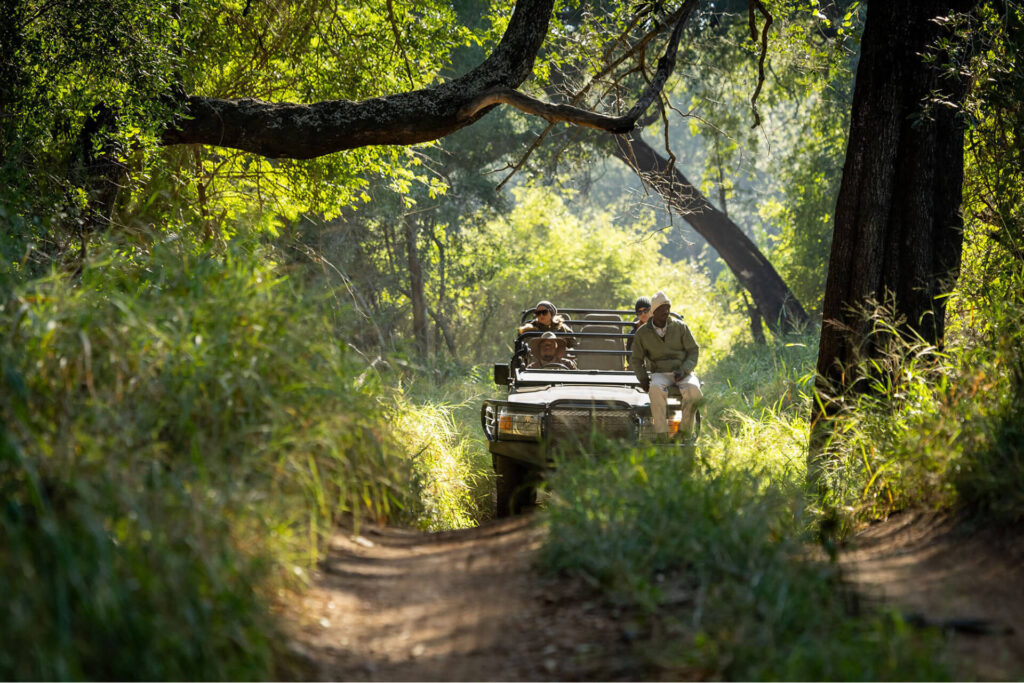
You head into the reserve in an open safari vehicle with your guide and tracker. Rather than following a fixed route towards a predetermined animal, the drive responds to what is happening in the landscape that day.
Sometimes you stop because something is there. Sometimes you stop because something was there.
Tracks, calls and animal behaviour can all become clues. And once something is found, your guide may switch off the engine and simply let you watch.
And occasionally, you turn a corner and find something nobody was searching for.
That’s part of it too.
Karongwe generally offers two guided game drives each day, with departure times changing seasonally.
How Close Will You Get to the Animals?
There isn’t one answer.
The appropriate viewing distance depends on the animal, its behaviour, the terrain, other vehicles at the sighting and the judgement of your guide.
Sometimes an animal may choose to move close to the vehicle. At other times, the right decision is to remain further away.
Good wildlife viewing isn’t about getting as close as possible. It’s about giving the animal space to behave naturally while allowing guests to observe without unnecessarily influencing what happens.
Closer isn’t always better.
What If You Don’t Find the Animal You’re Looking For?
It happens.
You may spend part of a drive following leopard tracks without ever finding the leopard. A lion heard calling before sunrise may have moved by the time you reach the area.
Then, while looking for something else entirely, elephants may emerge from the trees or African wild dogs appear on the road ahead.
That’s not a failed game drive. That’s safari.
Wildlife moves. Conditions change. Tracks disappear. The search itself is part of learning how the bush works.
And when an animal finally does appear after you’ve followed the signs that led to it, the sighting means considerably more.
Is Safari Really All About the Big Five?
The Big Five may bring you to the bush. They rarely remain the whole story.
Beyond the Big Five, Karongwe is home to cheetah and African wild dog, alongside giraffe, zebra, hippo, antelope, smaller predators, reptiles and abundant birdlife.
Then there are the things that don’t usually make a first-time safari wish list: a hornbill dust bathing, fresh tracks in the road, an impala alarm call or the sudden change in behaviour that makes your guide stop the vehicle.
As you spend more time on safari, your attention changes.
You start asking less, “What is it?” and more, “What is it doing?”




What Might Surprise You About Your First Safari?
Probably not the things you expect.
How cold an open vehicle can feel before sunrise in winter.
How quickly a vehicle full of people becomes silent when a leopard appears.
How much your tracker notices from a mark in the road.
How many sounds you begin recognising after only a few drives.
How different the same stretch of reserve can feel in the morning and afternoon.
And how much can be happening during the moments when, at first glance, there appears to be nothing happening at all.
Safari teaches you to look twice.
Your First Big Five Safari at Karongwe
At Karongwe, your first Big Five safari unfolds across a private reserve shaped by six river systems and varied Lowveld habitats.
Twice-daily game drives are led by experienced safari guides and trackers, with the Big Five sharing the landscape with cheetah, African wild dog and a much broader diversity of wildlife.
Located near Hoedspruit within the UNESCO-recognised Kruger to Canyons Biosphere, Karongwe is home to six safari lodges, each offering a different way to experience the same reserve.
But perhaps the most important thing Karongwe can offer a first-time safari guest isn’t a particular animal.
It’s the chance to learn how to look.
Come Looking for the Big Five. Notice Everything Else.
Your first safari may begin with five animals on a list.
Then the bush starts complicating things.
You follow tracks. You learn alarm calls. You wait. You miss things. You find things you weren’t looking for. And slowly, the landscape stops feeling like the space between sightings.
It becomes part of the sighting.
Come looking for the Big Five. Leave understanding a little more of the bush.
Explore Karongwe’s six safari lodges and discover where your first safari could begin.
Frequently Asked Questions
More Stories


